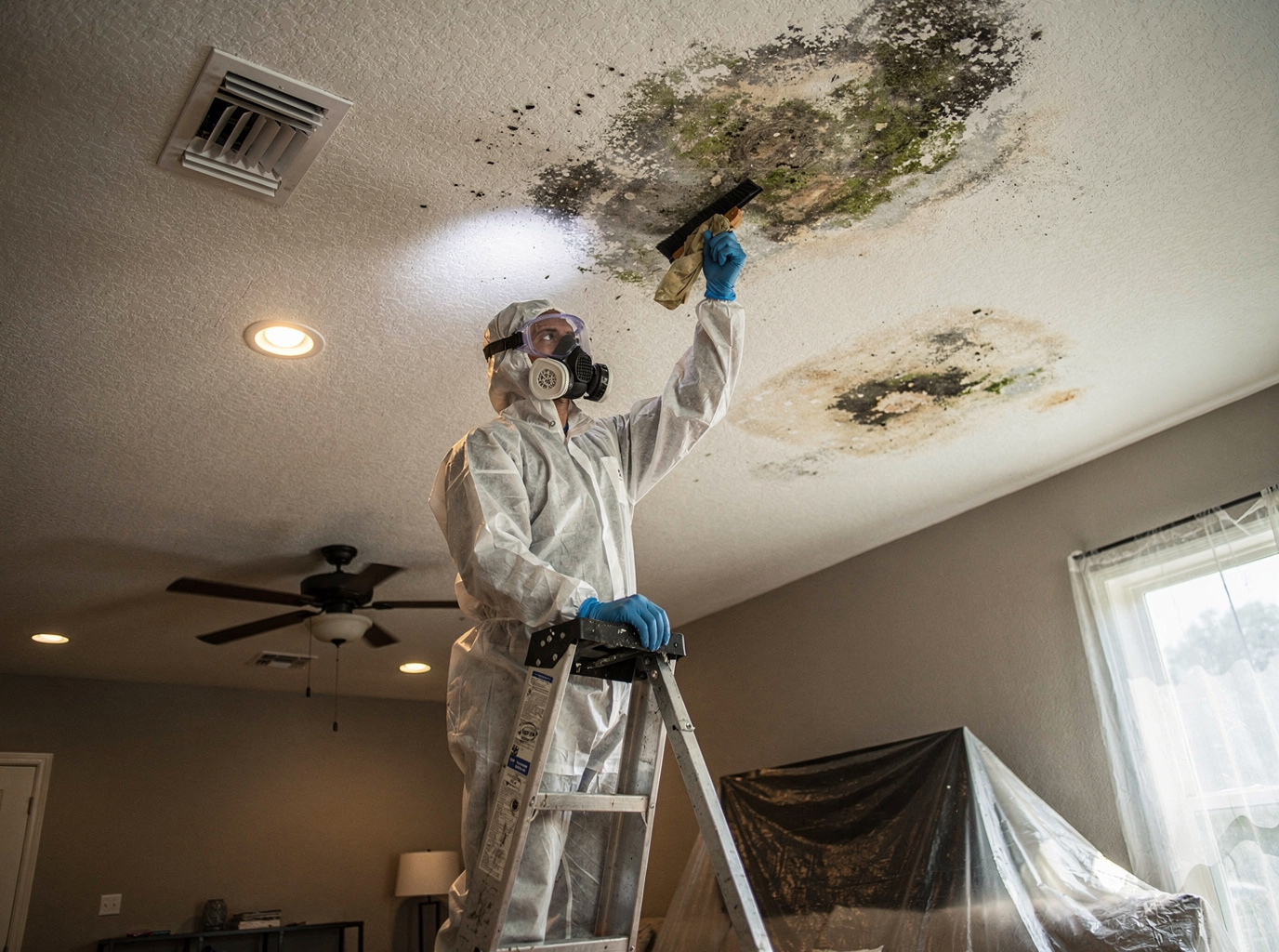
Houston's subtropical climate brings prolonged humidity that drives condensation on ceiling joists, especially in pre-1980 homes throughout the Heights and Montrose where plaster and lath ceilings meet poorly ventilated attics. Moisture from roof leaks or bathroom exhaust fans that terminate in the attic creates black mold colonies that spread along drywall seams and into insulation. Technicians must cut back affected material at least 18 inches past visible growth and use negative-air machines to keep spores from migrating into living spaces below.
In Midtown and Downtown high-rises or older River Oaks estates, ceiling mold often hides above dropped ceilings or ornate plasterwork where HVAC condensate lines drip. Removing these growths requires temporary removal of crown molding or access panels, followed by HEPA vacuuming and antimicrobial treatment on exposed wood. Homeowners in Katy, Sugar Land, and Pearland face similar issues after summer storms when roof flashing fails and water sits against ceiling drywall for weeks before discovery.
Harris County building practices and insurance requirements mean any ceiling mold job over 10 square feet usually needs documentation of moisture source correction before drywall replacement. Skipping the source fix, such as adding ridge vents or rerouting bath fans, almost guarantees recurrence during the next humid season. Work is scheduled around business hours at 6726 Theall Rd suite c, Monday through Friday 8am to 6pm and Saturday 9am to 2pm.
Technician insight
In Houston the thing that catches most people out with Ceiling Mold Removal is attic condensation from bathroom fans venting into the space instead of outside, especially in 1950s–1970s Heights bungalows where the subtropical humidity never drops enough for the ceiling to dry on its own.
Montrose Bungalow Ceiling Growth
A homeowner noticed dark staining along a bathroom ceiling after heavy spring rains. Inspection found roof flashing failure allowing water to pool above the drywall and feed mold into the attic insulation. Crew contained the room, removed the affected ceiling section, treated the joists, and added proper exhaust venting so the space stayed dry through the following humid summer.
Ceiling Mold Removal Services We Offer
✓Attic Ceiling Mold Inspection
Thermal imaging and moisture meter checks locate hidden growth above ceilings in Heights and Montrose homes before demolition begins.
✓Drywall Ceiling Removal
Controlled removal of contaminated drywall sections with containment barriers to protect finished spaces in River Oaks and Midtown properties.
✓Plaster Ceiling Mold Treatment
Specialized cleaning and encapsulation for historic plaster ceilings common in older Downtown and Heights structures without full demolition.
✓Attic Ventilation Correction
Installation of ridge vents and proper exhaust fan terminations to stop recurring condensation mold after initial remediation.
✓Post Remediation Clearance Testing
Third-party air and surface sampling to confirm safe spore levels before ceiling reconstruction in Harris County homes.
Ceiling Mold Removal Cost in Houston, TX
| Service | Typical Range | What Affects It |
|---|---|---|
| Initial Assessment And Testing | $250–$450 | Includes moisture mapping and basic sampling in single-story Heights or Montrose homes |
| Ceiling Mold Removal (under 50 sq ft) | $800–$1,600 | Standard drywall cutback and treatment; higher for plaster or tight attic access |
| Attic Ventilation Upgrade | $600–$1,200 | Ridge vent and fan rerouting to prevent recurrence in humid Houston summers |
| Clearance Testing | $300–$500 | Third-party air sampling required by many Harris County insurers |
Ranges are typical for Houston, TX and confirmed with an exact written quote before any work starts.
How it works
- 1
On-Site Assessment
Inspect ceiling cavities, measure moisture, and map affected areas using infrared cameras in the specific neighborhood home.
- 2
Containment Setup
Install plastic barriers and negative air to isolate the work zone from the rest of the Houston residence.
- 3
Material Removal
Cut out and bag contaminated drywall or insulation, treating exposed framing with EPA-registered solutions.
- 4
Drying And Source Fix
Dry the structure, correct leaks or ventilation issues, then apply preventive coatings.
- 5
Final Clearance
Conduct testing and document results before turning the space back over for reconstruction.
Pricing
Most ceiling mold jobs vary by square footage, access difficulty, and whether ventilation upgrades are needed.